
Governor J.B. Pritzker created the Illinois Accountability Commission to investigate Operation Midway Blitz and its impact on communities across Illinois.
The Commission collected and watched hundreds of hours of bodycam footage, held public hearings and community listening sessions, and created a public record representing one of the most comprehensive state-level investigations of federal law enforcement misconduct undertaken in recent American history. Below is what the Commission found.
unconstitutional use of force
“My life didn’t matter to them.”
— Marimar Martinez, who survived a shooting by a Border Patrol agent, testified about her experience.
Shootings
There were 2 officer-involved shootings during Operation Midway Blitz.
Silverio Villegas González, a father and cook originally from Mexico, was fatally shot by an ICE agent during a traffic stop in Franklin Park on September 12, 2025.
Marimar Martinez, an American citizen and teacher's aide, was shot five times by a Border Patrol agent who purposefully rammed into her car in Brighton Park. She survived.
Beatings
Officers frequently used unwarranted physical violence towards Chicago residents.
Ricardo Aguago Rodriguez was on his way home from a grocery store when he was attacked by officers. Border Patrol Agent Jesus Guillen pepper-sprayed, choked, and punched Rodriguez three times in the head. He was taken to the hospital for his injuries.
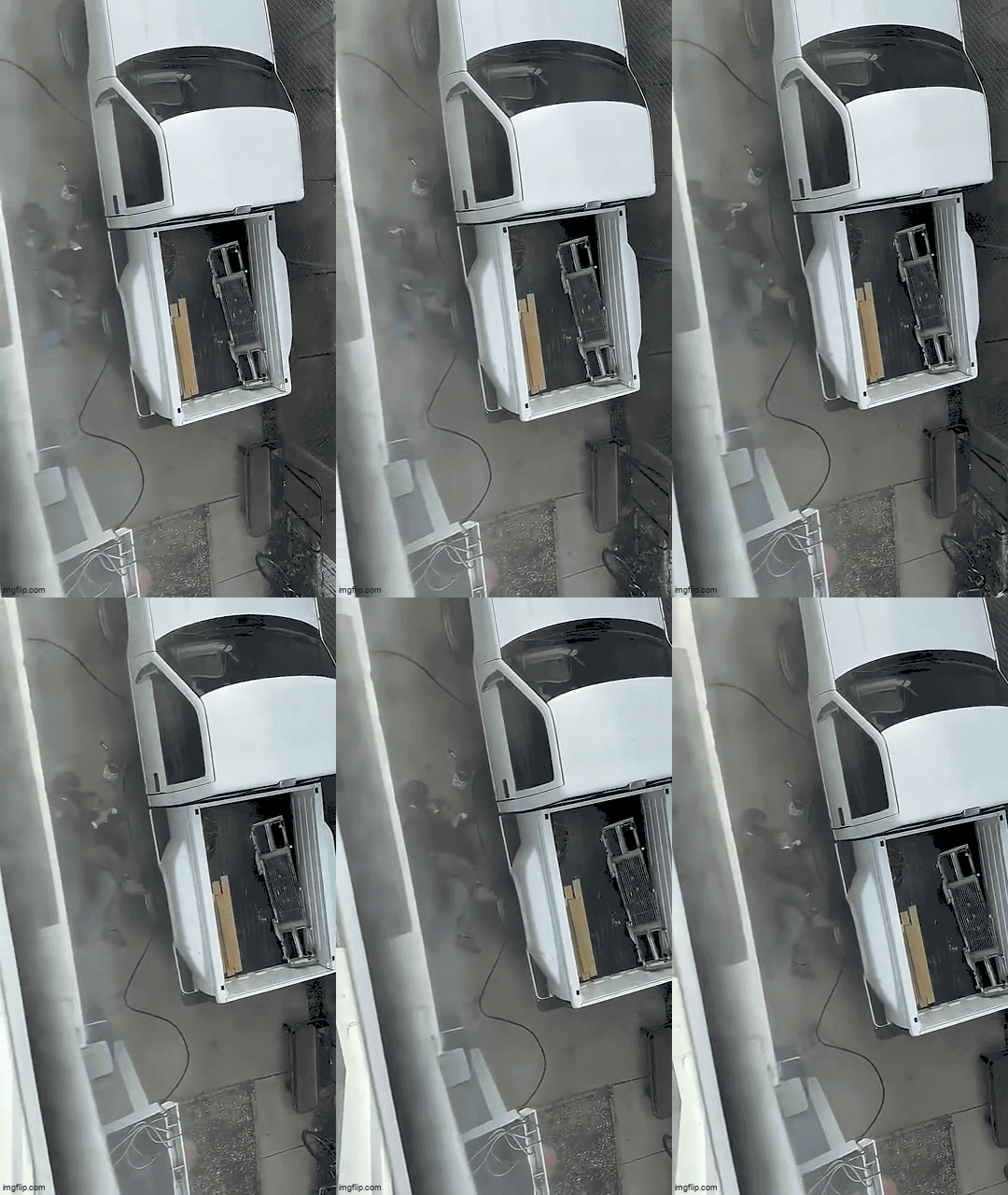
Bystander footage captured an agent punching Rodriguez in the head while holding an arm around his neck.
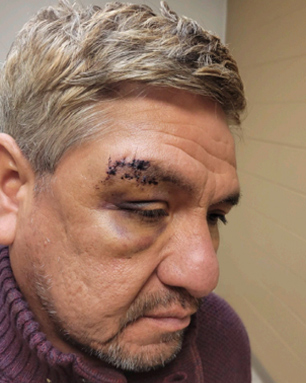
Rodriguez’ family says he suffered multiple broken teeth, broken ribs, and a dislocated collar bone, among other serious injuries.
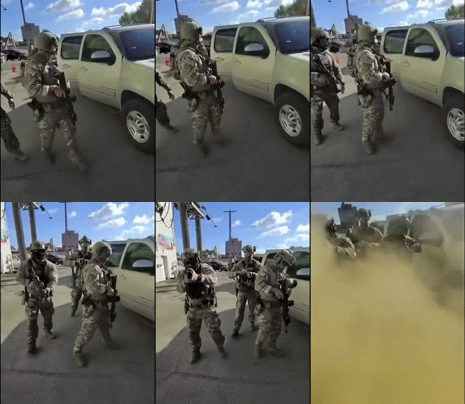
Little Village, November 5, 2025
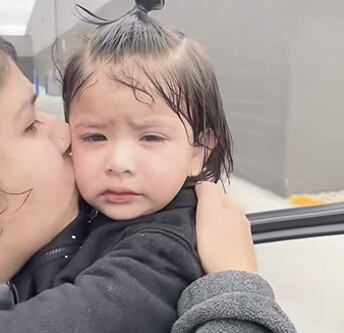
A young child exposed to tear gas in Cicero, Illinois, on November 8, 2025.
“Throw it for fun.” Watch bodycam footage of agents discuss throwing tear gas into a crowd.
Tear Gas
Chemical weapons were deployed on at least 63 different occasions during Operation Midway Blitz.
Little Village, November 5, 2025
A young child exposed to tear gas in Cicero, Illinois, on November 8, 2025.
“Throw it for fun.” Watch bodycam footage of agents discuss throwing tear gas into a crowd.
On November 8th, 2025 in Chicago’s Little Village neighborhood, officers threw 15 rounds of tear gas and pepper spray into the crowd, marking the largest deployment of chemical weapons in Chicago in 60 years.
At every opportunity they dialed up the brutality, the terror, and it was clear that they were doing it just to inflict pain and terror and the cruelty was the point.
Illegal arrests and profiling
The Commission found evidence of rampant racial profiling, with officers appearing to stop people based only on their apparent race, ethnicity, or workplace. Officers questioned people about their citizenship and made unlawful, warrantless arrests.
“Where were you born?”
Bodycam footage from October 24, 2025, shows racial profiling from federal agents in Chicago’s Lake View neighborhood.
THE GEOGRAPHY OF OPERATION MIDWAY BLITZ
Federal officers repeatedly endangered community safety. Their activity occurred across the Chicagoland area.
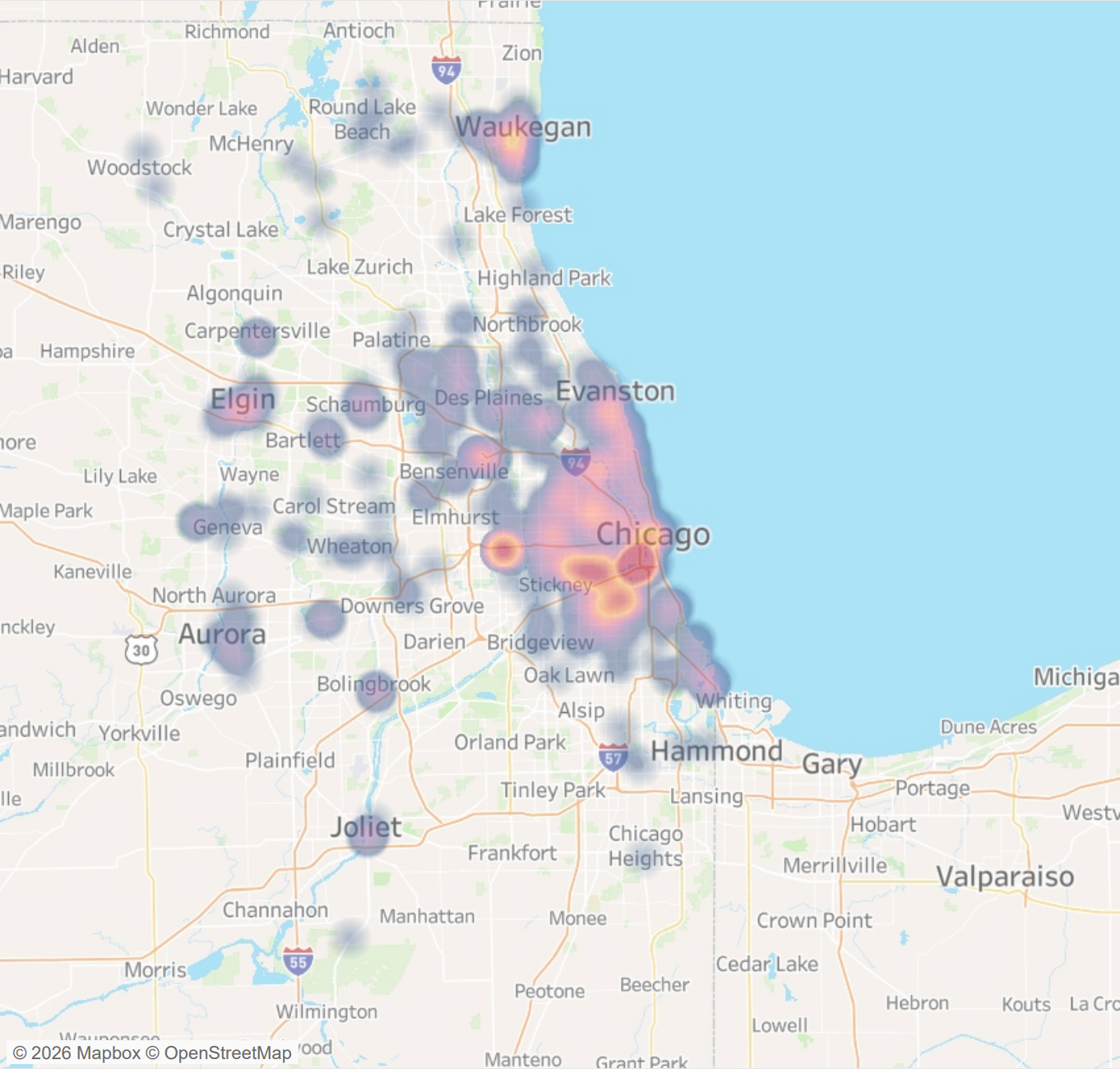
Source: Cline Center Firewatch heatmap showing the locations of 510 destabilizing government acts initiated by federal actors between September 1, 2025 and January 30, 2026 as part of Operation Midway Blitz.
This heat map reflects an analysis of publicly reported incidents done through the Cline Center, a research partner of the Commission. It is not a complete list of the incidents, but demonstrates that no corner of the region was untouched by this enforcement, and Chicagoans of all races, ethnicities, socioeconomic statuses were impacted.
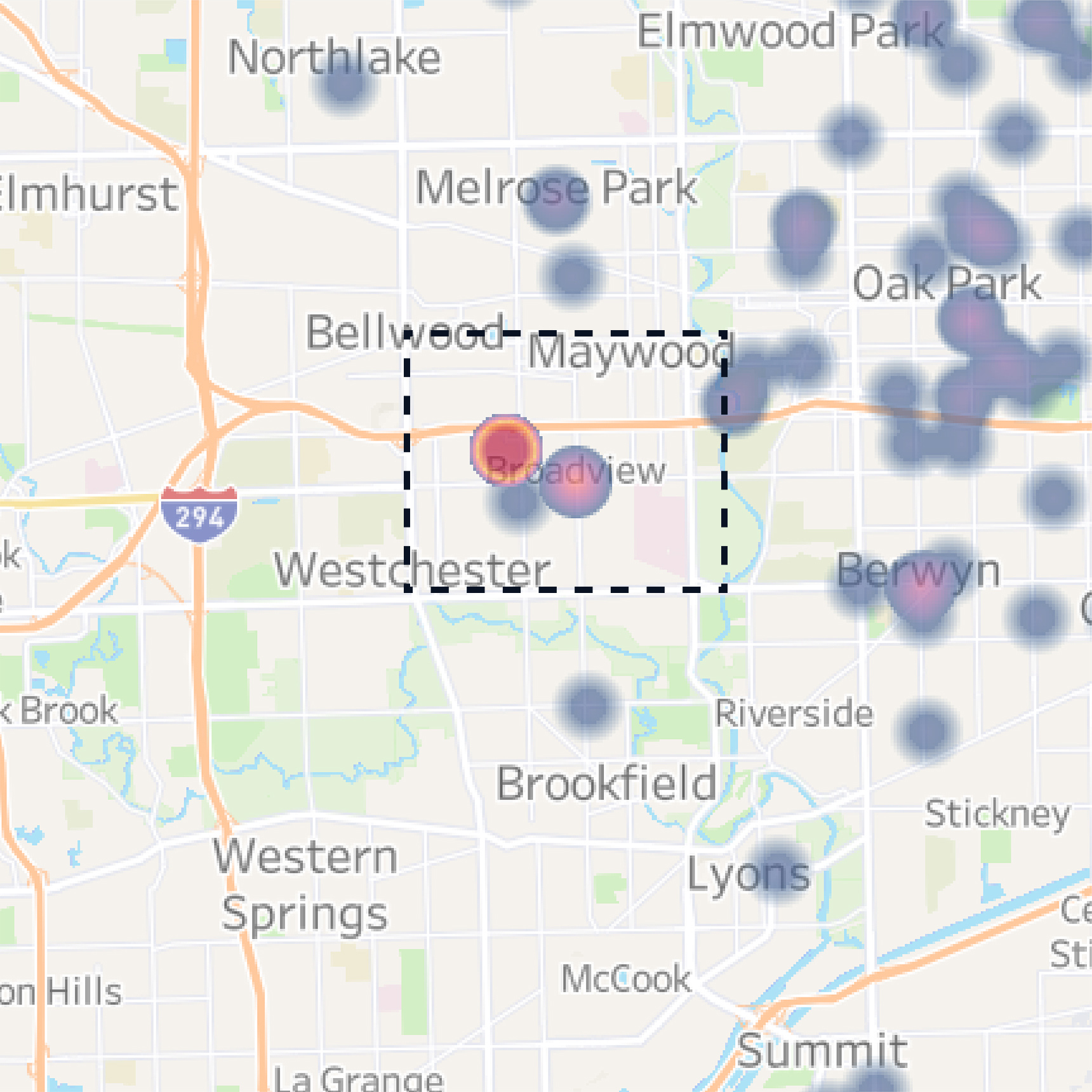
Source: Cline Center Firewatch heatmap showing the locations of 510 destabilizing government acts initiated by federal actors between September 1, 2025 and January 30, 2026 as part of Operation Midway Blitz.
Notably, the map highlights two areas with higher numbers of reported incidents. The first is:
ICE Broadview Processing Center in Broadview, Illinois which became the site of sustained, near-daily protests during the Operation Midway Blitz, where federal agents repeatedly used tear gas, pepper spray, and flash-bang grenades against protesters, clergy, and journalists.
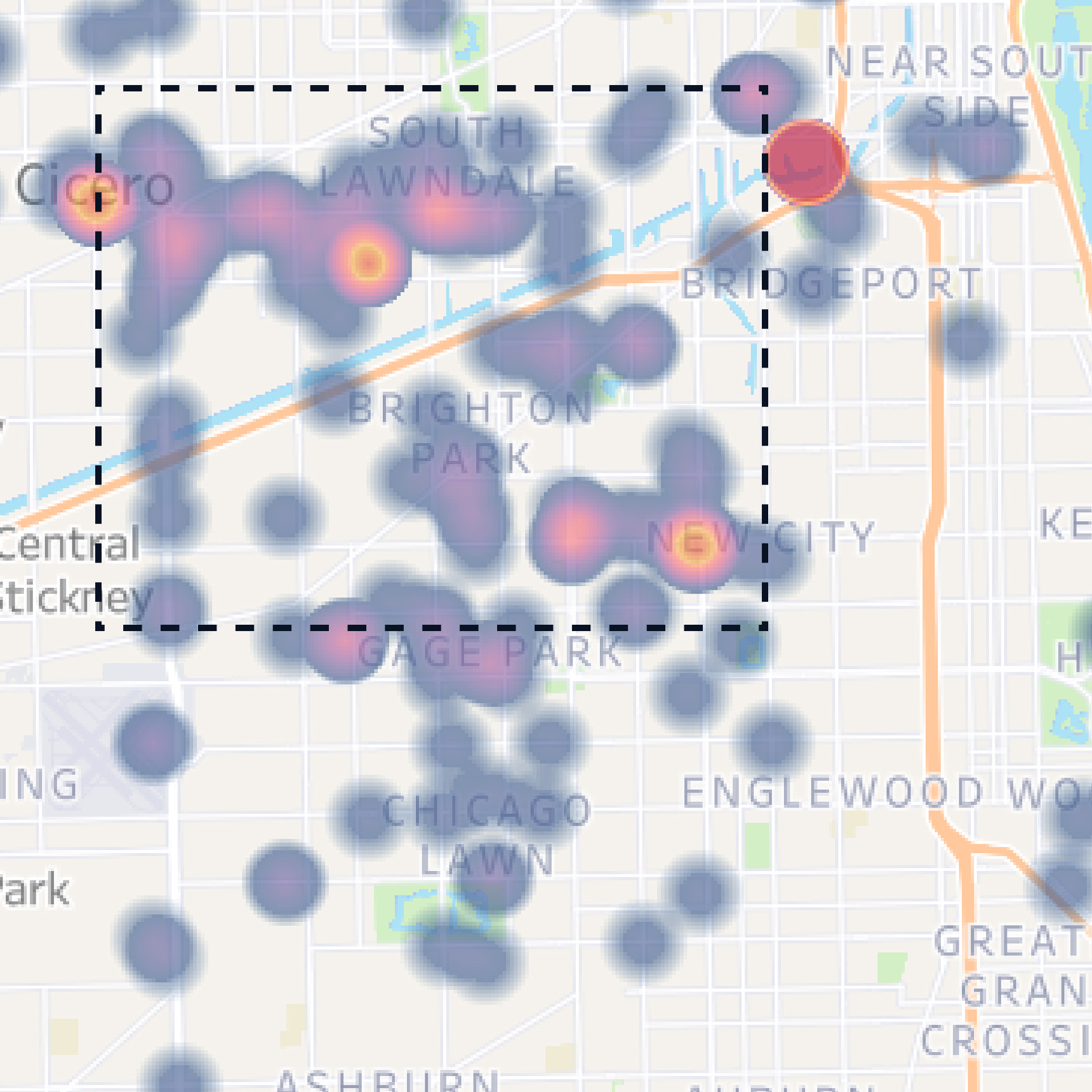
Source: Cline Center Firewatch heatmap showing the locations of 510 destabilizing government acts initiated by federal actors between September 1, 2025 and January 30, 2026 as part of Operation Midway Blitz.
See the Illinois Accountability Commission’s investigation briefs on incidents in Little Village and Brighton Park.
The second area with higher numbers of reported incidents:
Chicago neighborhoods and suburbs along the southwest side of the city with predominant Latino populations.
See the Illinois Accountability Commission’s investigation briefs on incidents in Little Village and Brighton Park.
inhumane detention
People, including many with pathways to legal status, were detained in inhumane conditions in an attempt to coerce “self-deportation.”
“They refused to give him lifesaving medication.”
— Rabia Amin, testifying about her father’s experience in detention
Below, listen to real accounts from people detained inside Broadview, read by actors.
Scroll up and down to navigate between cards
When people asked for medical attention, the officers told them to be quiet.”
JOSE GUERRERO POZOS
People had to sleep curled up in order not to touch other people.”
WILLIAN GIMÉNEZ GONZÁLEZ
He told me that if I did not sign the [deportation] paperwork, I would remain detained.”
CLAUDIA CAROLINA PEREIRA GEUVARA
From Sept. 8 through Oct. 15 [2025], at least 154 people who were initially booked into Broadview self-deported, more than nearly every other ICE detention facility in the nation during that time.
"There were no beds, sleeping pads, pillows, or bedding. There were no tables. There was no place to sleep. You could try to sleep by sitting on a hard plastic bench up against the wall. If you were lucky, you got a foil 'blanket' to cover yourself. …
There was no sink to wash your hands. There was no water, soap, or hand sanitizer. There were no showers. We had to ask the officers for toilet paper. There was no medical unit. We had no access to medical services. When people asked for medical attention, the officers told them to be quiet."
"At night, we were moved to a larger room with around 50 seats and 15 people. There were two toilets available that were exposed to the room and afforded no privacy. There was no opportunity to bathe or shower. There was a shower fixture in the room, but a sign on it read 'out of order.' The room stank of body odor.
At night, it was impossible to sleep. The room was freezing cold. There were no beds or mats to sleep on. Instead, we each lay across three seats. We had no bedding, but two metallic foil blankets. The blankets made a loud rustling noise that continued all night. The bright lights in the room were kept on all night."
“The room was extremely overcrowded. There were around 40 or 50 people inside the room. The room was maybe 3.5 meters long and 3.5 meters wide. There was not enough room for all of the people in my holding cell to sleep properly.
People had to sleep curled up in order not to touch other people. If one person stretched, they would hit someone else.”
“There was no privacy at all. Everyone could see others using the toilet.
I saw a man get sick and vomit in and around the toilet. The man received no medical care. No officers came to clean up the vomit. It smelled terrible, and people tried to use toilet paper to clean up the vomit.”
“The officer told me that I had to sign my deportation paperwork. He told me that if I did not sign the paperwork, I would remain detained there at Broadview until I agreed to sign. I felt that I had no choice but to sign the paperwork.
The deportation paperwork was in English, but I am not able to read English. The deportation paperwork was not provided to me in Spanish, a language that I know and understand. … The immigration officers did not provide me any information about my legal options. Their only goal was to deport as many people as possible as fast as possible.”